

Introduction
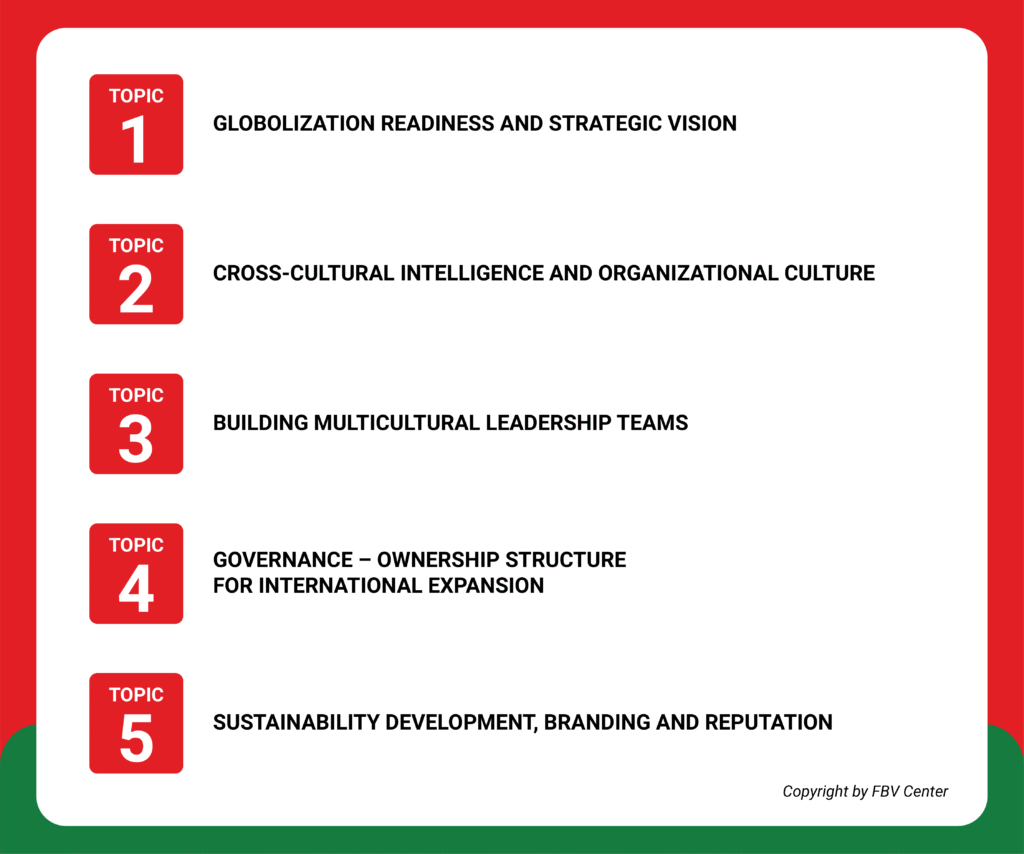
The internationalisation of a family business is the process in which a family-owned or family-controlled company expands its operations beyond national borders through forms such as exporting, joint ventures, foreign direct investment (FDI), or establishing subsidiaries abroad. Internationalisation is a strategic opportunity for family businesses to scale up, achieve sustainable growth, and strengthen their global position. However, family businesses face major challenges in this process: building a vision and strategy for internationalisation, managing cross-cultural organisations while balancing family culture, preparing leaders and successors with international business competence, managing multicultural talent, adapting corporate structures to global standards, and protecting family assets while accepting risk. Therefore, internationalising a family business means adapting to global business while ensuring the long-term continuity of the family legacy.
The Internationalisation of Family Business course is designed to provide a structured framework for internationalisation and to help family businesses create a clear roadmap for their “long journey” into globalisation.
Key benefits of the program for family businesses include:
- Shaping a global vision and strategy while preserving family identity.
- Understanding and applying tools to assess internal capacity and readiness for internationalisation.
- Building leadership capabilities and governance structures suitable for multinational environments.
- Managing risks, value conflicts, and succession strategies during global expansion. Leveraging corporate culture and family values to create a sustainable competitive advantage worldwide.
- Developing multicultural talent strategies to support internationalisation.
This program is designed for:
- Family business leaders and family members preparing for succession.
- Entrepreneurs starting their businesses and preparing the next generation.
- Managers seek to understand family businesses in order to work effectively and integrate into this model.
Program format:
The program runs for 30 hours (customisable), delivered by experienced researchers and consultants. Materials and content are standardised based on leading research and reputable publications in the field of family business. Classes are offered on a customised, “tailored” basis to address the specific issues of participants. Mode of delivery: in-person training.
Content
Reference
- Harvard Business Review Family Business Handbook: How to Build and Sustain a Successful, Enduring Enterprise
- Understanding the Family Business: Exploring the Differences Between Family and Nonfamily Businesses
- Generation to Generation: Life Cycles of the Family Business. Authors: Kelin E.Gersick, John A. Davis, Marion McCollom Hampton, Ivan Lansberg
- Succeeding Generations: Realizing the Dream of Families in Business.Author:Ivan Lansberg
- Developing Next Generation Leaders for Transgenerational Entrepreneurial Family Enterprises. Authors: Pramodita Sharma, et al.
- Bjuggren, P. O., & Sund, L. G. (2001). Strategic decision making in intergenerational successions of small- and medium-size family-owned businesses. Family Business Review, 14(1), 11–23.
- Ang, S., Van Dyne, L., Koh, C., Ng, K. Y., Templer, K. J., Tay, C., & Chandrasekar, N. A. (2007). Cultural Intelligence: Its measurement and effects on cultural judgment and decision making, cultural adaptation and task performance. Management and Organization Review, 3(3), 335–371
- Fernández, Z., & Nieto, M. J. (2005). Internationalization strategy of small and medium-sized family businesses: Some influential factors. Family Business Review, 18(1), 77–89.
- Zahra, S.A. (2003), Internationalization of Family Firms: A Resource-Based View, Academy of Management Journal
- Kontinen, T. & Ojala, A. (2010), Going Global: The Dynamics of Family Firms Internationalization, Journal of Small Business and Enterprise Development
- Pukall, T. J., & Calabrò, A. (2014), The Internationalization of Family SMEs: The Impact of Ownership, Governance, and Top Management Team
- Debicki, B. J., Matherne, C. F., Kellermanns, F. W., & Chrisman, J. J. (2009), Cross-Cultural Competence and International Strategy in Family Firms